
It is your senior year of high school, and as spring approaches you and all of your peers await the butterfly-inducing college rejection or acceptance letters. Oh my goodness! This is it. You just received an acceptance email from your dream school. You run, and jump and scream with joy…but wait…how are you going to afford such an exclusive education?
As the cost of higher education increases, it becomes less and less attainable for students who are not willing to take on thousands of dollars of debt, or those who do not have the ability to receive grants, a partial or a full ride scholarship.
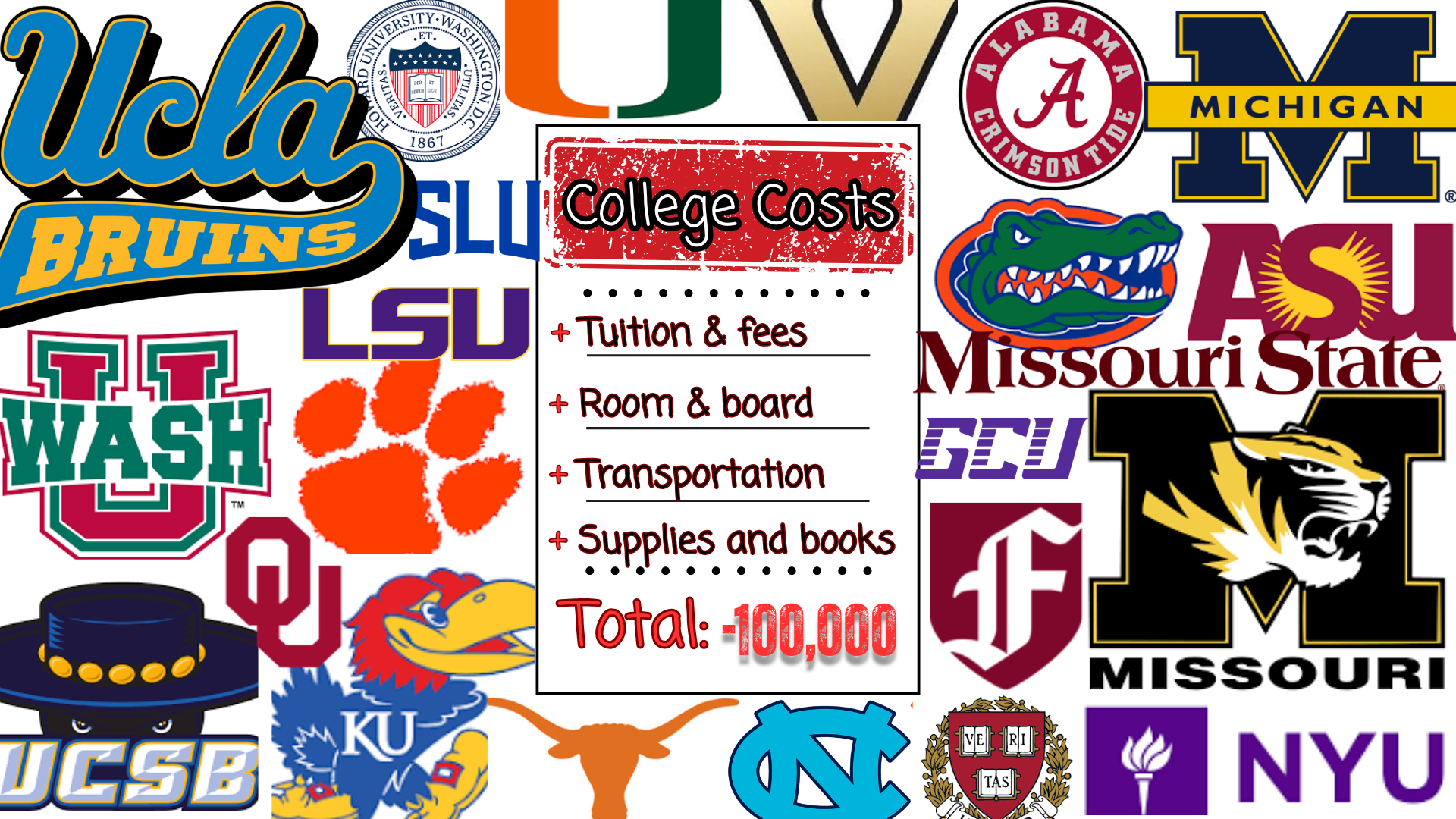
The National Center for Education Statistics says that the average total cost for full time students at all post-secondary institutions was $1,248 in the 1963-1964 school year – which would be equal to around $12,126 in 2023. Whereas the average price of total tuition, fees, room and board for the 2022-2023 school year was $27,673. Meaning, that the cost of higher education has more than doubled since the ‘60s.
Because the cost of college has doubled in the last decades, it has obviously become harder for students and their families to pay for their tuition. Most people can not afford to pay tens of thousands of dollars for a year of tuition, let alone for four years of schooling.
“The average cost of attendance for a student living on campus at an in-state public 4-year institution is $27,146 per year or $108,584 over 4 years… Students unable to work full-time stand to lose a median annual income of $46,748.” The Education Data Initiative, said.
This increase in pricing has drastically increased the reliance that students have on scholarships to relieve some of the cost. This has subsequently led to the requirements of most scholarships to increase. Students find themselves having to take multiple AP classes each year, studying for hours upon hours to have straight A’s and taking as many extra-curriculars as possible, just to receive a partial scholarship.
“I have been class Vice president both my junior and senior year, ran cross country and track all four years of high school, taken nine AP classes and I have a 4.362 GPA. I have led and been a member of multiple school clubs such as the International Student Association, Student Council, National Honors Society and the thrive scholars program. I also started a youth led road safety campaign.” West senior Frank Mwangi said.
Mwangi is one of many dedicated and hardworking students, who have fortunately realized the lengths that may be necessary to obtain a scholarship for school. However, the reality of receiving a full-ride scholarship, or any amount of money that would keep the cost of college from being detrimental is unlikely. Especially for students that do not go out of their way to receive such merit. The reality is that most people need scholarships to afford college, but the likelihood of receiving one is not so probable.
“Only one in eight college students is awarded a scholarship. 97% of students that are awarded scholarships received less than $2,500. Only 0.2% of students receive scholarships worth $25,000 or more. Full-ride scholarships (education + living expenses) are awarded to only about 0.1% of students.” Search Logistics, said.
For students that can not afford college on their own, and are not able to receive extensive scholarships or grants, the only options that seem to be left are settling for a school they do not really want to go to, for its affordability or taking out a student loan to go to their dream school. And for some students, loans are a necessity wherever they go to school. This form of payment, while initially beneficial, can cause people to take on a lot of debt, And on top of that, most loans have interest that make it harder to pay back in a reasonable amount of time.
“Ten years is the ideal timeline for paying off student loan debt according to financial experts and the U.S. Department of Education…In practice, it takes borrowers closer to 20 years to pay off their student loans. And, Student loan interest rates for 2024-25 are the highest in a decade. At 6.53%.” The Education Data Initiative, said.
For the 2025-2026 school year, the interest rate for undergraduate student loans has narrowly decreased, at 6.39%. The interest on student loans increasing as they are not paid, creates a cycle where a person has the money to pay off some of their debt, but the cost of the loan has increased, so the payment is not really substantial enough to lessen the debt. This traps a lot of Americans, as student loans are typically put on the back-burner when the other costs of life such as housing, medical bills and childcare are added into the equation. Creating a system where most people do not start paying off their student loans until later in life.
“For undergrad, I took about $25,000 out in student loans, and for graduate I took out $50,000, and I still have another year left of school. I finished undergrad in December of 2020, which was almost six years ago. And, I have not paid off any of the cost yet,” Ms. Mackenzie Day, a West Journalism teacher, said.
For many college applicants, as the cost of college increases, the need for scholarships and federal aid increases. As the need for federal aid increases, the accumulation of student loan debt increases. And as the probable amount of debt increases, the desire for a prestigious higher education starts to falter. Realistically, a person could be making $100,000 a year as a doctor, but be $200,000 in debt just from undergraduate loans. Such drastic amounts of debt deter people from choosing their dream school, or their dream career, because the cost of a four year college education will likely be much more expensive than four years worth of most Americans salaries.